Embroidered BRAILLE
This work explores digitally embroidered Braille as a design space
that supports DIY making of everyday applications. We introduce
three accessible digital workflows for creating Braille embroidery:
specification-based manual layouts, traced outputs from online
Braille translators, and built-in Braille symbol libraries in commercial
embroidery software. Through controlled embroidery experiments,
we explore how digital Braille workflows and embroidery
parameters are realized through the fabrication process. Beyond
technical feasibility, we demonstrate how embroidered Braille enables
new forms of user empowerment through applications including
educational STEM kits, cultural sampler books, accessible
research posters, personalized household labels, personal items for
self-expression, and intergenerational heirlooms. By foregrounding
accessible workflows and real-world applications, we contribute
practical insights for integrating Braille into fabric-based artifacts,
supporting broader participation in tactile making, learning, and
self-expression. Future work will involve user studies to evaluate
legibility and experiential qualities insights from lived experiences
with embroidered Braille across these workflows and applications.
Embroidered
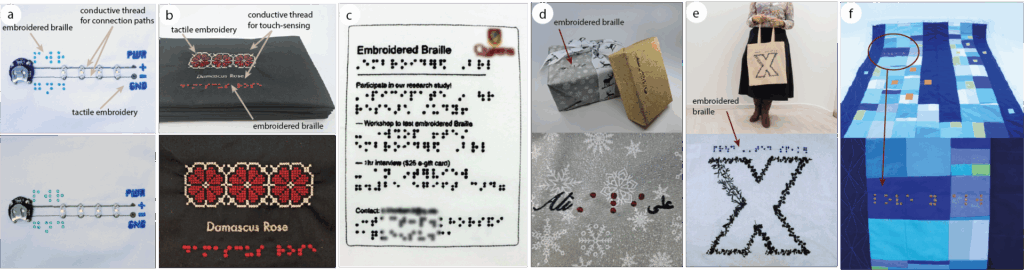
Braille can be used for name labeling on personalized items
such as gift wrappings, as well as on everyday personal belongings
like towels or bedding. We explore multi-lingual name labels with
this technique for independent living (on hand towels) and inclusive
festive (on holiday presents). These tactile labels
support independent identification and reduce reliance on visual
or implicit material qualities. Instead, such applications provide
explicit tactile cues and add a personalized crafted layer to otherwise
ordinary domestic objects, blending accessibility into everyday
things. This supports the Maker Culture where individuals can use
local libraries and makerspaces that have embroidery machines to
DIY their Braille labels for themselves and their loved ones.
Braille embroidery
can also enable self-expression on garments and accessories.
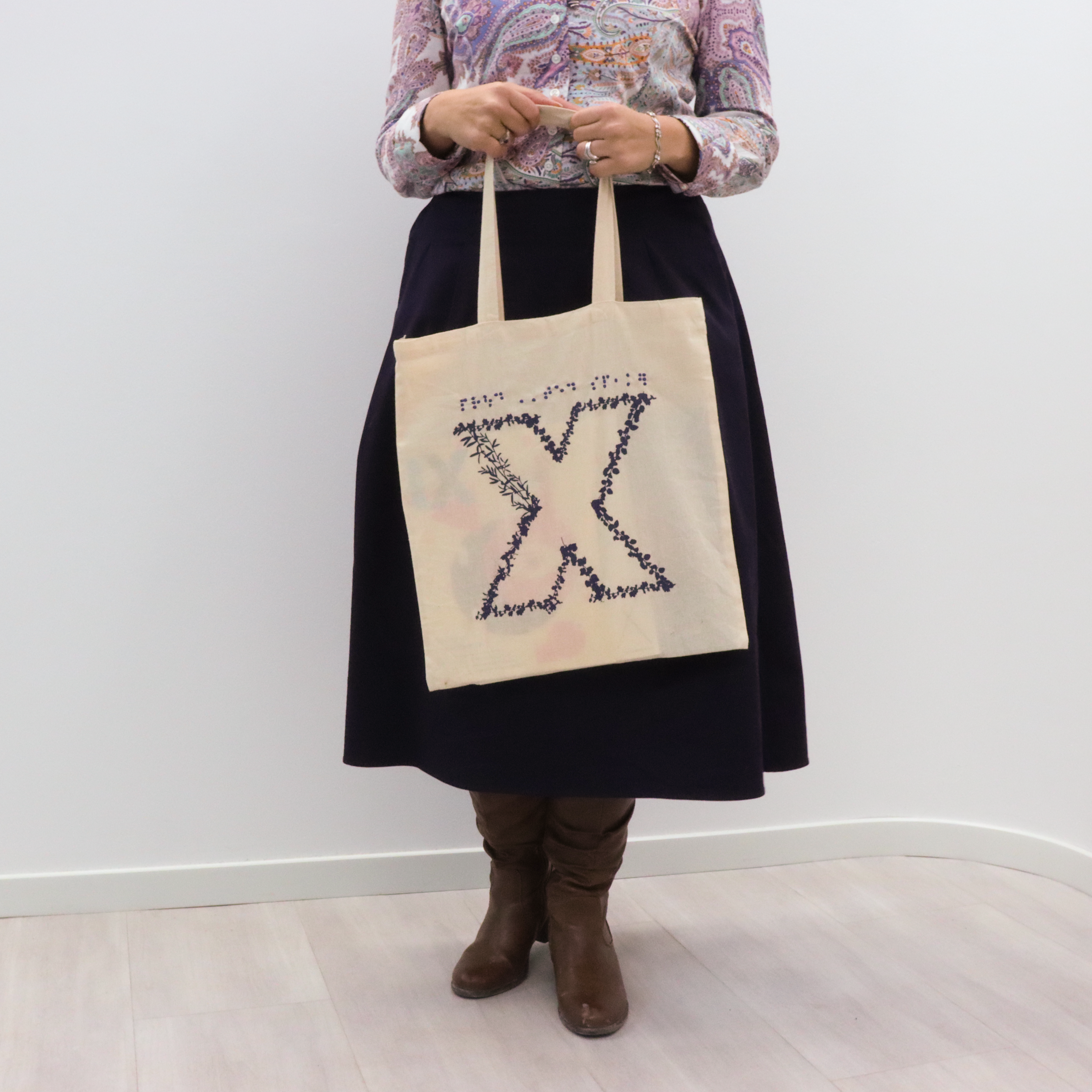
We explored such applications by creating t-shirt mottos and tote
bags with personal identity motifs, where tactile text communicates
values, humor, or personal messages. For instance, Figure 1.e
shows a tote bag that we embroidered using our technique with
Braille text saying “Proud TED Speaker”. Unlike printed text, embroidered
Braille introduces a private or selectively accessible layer of
expression that can be felt rather than seen. While some commercial
products feature Braille text, they usually use post-fabrication processes
or components that is not an integral part of the textile. allowing wearers to encode
identity, affiliation, or statements in a tactile and materially
expressive form.
Publication
Acknowledgment
This project was funded by the Natural Sciences and Engineering
Research Council of Canada (NSERC) Discovery Grant (2021-04135).
The iStudio equipment was funded by the Canada Foundation for
Innovation - John R. Evans Leaders Fund (CFI-JELF: 41215), Ontario
Research Fund, and the NSERC RTI (Research Tools and Instruments)
Grant (2021-00079).